
ROSE RENT: poems by Susan Taylor
Turret Books, 1987, limited edition pamphlet
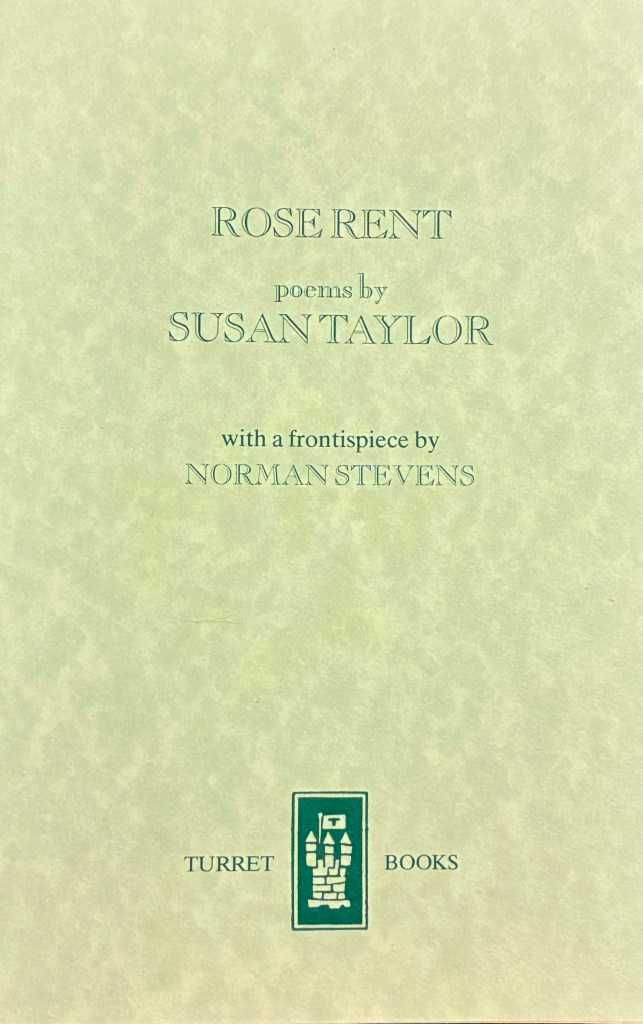
Susan Taylor’s complicated relationship with the land – not so much the great outdoors but, on a more practical level, rural life, fields, farming and landscape – is what lies at the heart of Rose Rent (‘an ancient nominal rental agreement,’ Taylor explains, ‘whereby a single rose is tendered at midsummer’), a collection of twenty-one poems published in 1987 in a beautiful pale green pamphlet. These poems are also about love, emotion and relationships, including that unfailing love for the land, even if her relationship to it changes over time; there’s a transition taking place early on here between one state and another, marked by the frustration of being forced indoors at last, tethered to one spot by motherhood.
Taylor’s treatment of the soil and livestock isn’t pastoral or bucolic, as with so many other poets who dig here, but tougher and more visceral, born of the daily reality of farming and harsh winters. Similarly, there are hands-on Hughesian echoes to some of her farming references, underscored by connections between the poet Ted Hughes and the Arvon Foundation at Totleigh Barton in rural Devon where she was centre director in the early 1980s.
I helped lambs to be born into blizzards
and, day after day, ripped swedes
like teeth from gums of solid clay
she writes in one of the key poems in this pamphlet, ‘Settled in Sheepwash’ (a village near the Arvon centre).
But pregnancy eventually interferes with her country instincts: hearing lambs bleat outside in the village street that runs between farms, she admits, ‘It isn’t easy to sit behind a sill of hothouse plants/and watch the dust build up against the window.’ Like the flowers, the poet seems to feel out of place in this domestic setting, kept under cover for her own protection. But her mounting emotions give rise to poetry. Where her later poems will be richly detailed but often informal, even conversational at times, these earlier offerings feel more sparing and delicate. Taylor here is rearranging and testing the boundaries of her world, like the carefully crafted paper creations in ‘Origami’ where ‘Your fold, unfold, refold/and faith in simple structure/becomes flesh, or feather’.
‘I love this land,’ Taylor writes in the title poem, ‘it is my life charm.’ Her descriptions of the natural world illustrate this passion with an uncannily accurate eye. Humble cow parsley in the poem ‘July Ambush’ becomes ‘Full saucers of cream/spread over dim roods’ while snow ‘lifts up in chunks like marble’ in ‘Snowman’. In ‘Celebration,’ a charming poem of how nature invades human lives and spaces, ‘a toad hides behind the sink,’ ‘A hare crosses the field with the moon’ and ‘Down green twined lanes the bellbines arc/against a swell of shade.’ A lifestyle is being shaped here, delicately shaded and coloured in while we read.
There is music here too. The songs and rhythms of nature – ‘Outside a chaffinch shouts cha-cha!’ (‘Leavetaking’) – and in the poignant poem ‘Hard Hands’ we are asked to think of the music humans make (or would make if they were not so caught up in the complicated business of life and parenting):
Where there was song,

a guitar lay in its case for seven years;

long, black and silent as a coffin.
Susan Taylor is a poet with tremendous range and profound vision whose work has not received the wider recognition it deserves, and Rose Rent is an early selection of poems from her; yet even here, we see the signs of her career to come.

The closing image of this short but powerful collection is brutal, raw and yet all part and parcel of Taylor’s complex relationship to the land and folklore. In ‘Hard Hands,’ a girl is carrying dead hares to market, ‘huge hares with globes for eyes,/their legs stiffly stretched.’ Yet – as her use of ‘globes for eyes’ suggests, this too is an integral part of farming and the natural world too, and also of prey and predator; this is ‘the grief of the fields,’ Taylor tells us, and in the final lines below we gain some inkling of poems to come from her in later collections, poems of performance and display, with themes closely allied to women’s lives and bodies, often presented via her striking use of metaphor, allegory, myth and legend.
They smelt dangerously of blood.

Bare arms raised, I carried them like sisters,

and how the men stared.
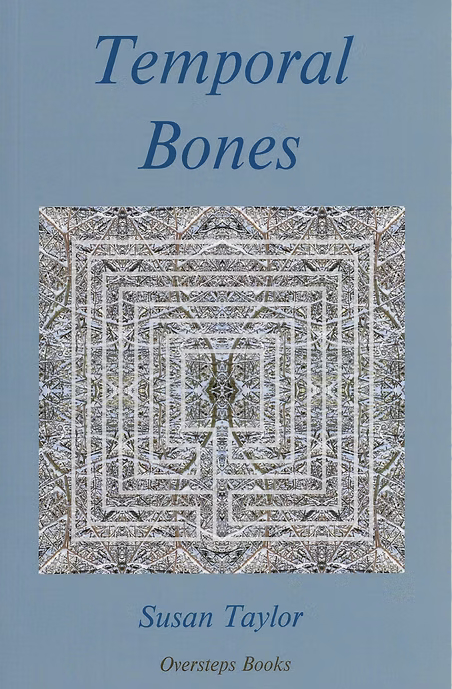
TEMPORAL BONES, Susan Taylor
Oversteps Books, 2016
£8
The poems in Susan Taylor’s later collection Temporal Bones are ‘little flaming torches’ [‘Paradigm in Paradise’] to light your way through a poetic hinterland by turns mythical, allegorical, ekphrastic. Here, you will soon ‘pass around the drinking cup,/to let a tune run in your head’ [Troll Comeback], becoming both audience and storyteller as you read. Myths and legends under examination in this nicely produced collection include the Dartmoor tale of ‘Jan Coo’, told quasi-ballad style with the poet’s trademark atmospheric description. Taylor’s voice here, like that of the lost boy Jan Coo himself, is haunting, repetitive and yet often elusive too, her meaning always just around the next corner: ‘where the Dart tumbles out of sight,/a fair way down the valley in the oaks.’
Persephone also features, tasting ‘the seeds of underworld…/… Fragrant and richly bitter’ in ‘Her Fields’. Human tongues, Persephone tells us, have ‘misrepresented’ the seeds of her captivity under the earth: in fact, she says, ‘I have gifts to give/that I took out of grief.’ Taylor’s poems teach hard lessons, then, but fruitful ones that cannot be learnt ‘from the scent of herbs/or the feel of sun on them.’
Despite a natural inclination towards darkness, Taylor also gives us poems intent on ‘the fecundity of the bees’ in a ‘glut of new blooms’ [‘Spend the Night in Our House until Dawn’], and a deep, sensual awareness of life ‘incandescent with nectar’. Dark at times, yes, but this is an erotic darkness, ‘humming with procreation’. Indeed, there is much vivid new life in the first half of Temporal Bones: the lady with the ‘green girdle’ loves to play with her Lord or Wodwo among the meadowsweet [‘The Gift of the Green Girdle’] while in ‘The Call to Green’, Taylor reimagines a somewhat exhibitionist Green Knight on his dappled green stallion:
He needs no breeches
restricting his grip;
greenwood plays febrile
over his naked thighs.
Taylor is revisiting old themes or stories steeped in magic and folklore here, but her poems tend to depict a natural rather than mythologised world, where its own ‘creatures perform the netherworld;/not heaven, earth or hell’ [‘Iris’]. It’s a deceptive world that, like the ivy in her poem ‘First Foot’, comes ‘grasping at you’ but where only the unwary need be alarmed. For those who understand the turn of each season, the seeds of such sinister plants and fruits can be ‘a wren’s wishbone:/a small thing caught at the gate of the year’ in the right hands [‘The Apple Hold’]. A talisman to be used as a defence against darkness, in other words, or a portal into some new and illuminating world.
The second half of Temporal Bones consists of an eerie and substantial poem sequence inspired by an Inuit myth and entitled Skeleton Woman. I’m a huge fan of writing poem sequences myself, as they’re often an excellent way of focusing the imagination where vaguer or more general ideas for poems may prove harder to come by, in particular during periods of creative drought or a crisis of confidence, or at least not without a great deal of revision work. Some topics call more naturally to some poets than others, and while some might find the skeleton woman’s story unsettling – a fisherman nets a young woman’s skeleton and unwittingly resurrects her with ‘a tear released’ to become his lover – Taylor uses such darkness as an impetus, many lines here spell-like and powerfully alliterative as the two lovers take turns to speak through her poems:
No telling when waves will rear up
tormenting until they swallow a soul,
so I sing in hope the sea keeps calm
and trust the fishermen hear me.
[‘Whatever I am Sings’]
Among other echoes – such as the story of Pygmalion, where the created ‘woman’ comes to life to pleasure her creator – these Inuit myths also touch on the ancient human fear of drowning in the sea’s immensity. In ‘Sedna’s Song’ a young woman ‘alone/down here in the ocean’s bone’ is cruelly abandoned at sea by her own father, yet finds new life in the depths as an Arctic goddess, providing much-needed food for the region. These are poems of despair and triumph, of women’s resilience in the face of loneliness and betrayal, and yet there is also empathy for the ‘other’, for the fishermen drawn in by feminine mysteries only to flee in terror, the pure feminine archetype more than they can handle. There is less empathy on show here for father figures who covet, murder and abandon their own daughters. Taylor is as merciless as the fathers here: we know who to blame for such tragedies. And if the seductive dead occasionally take their revenge on the unwary, perhaps they can be forgiven after the treatment they received while alive:
Come sip at the dark, my darkness
loaded with splinters of ice
[‘Skeleton Key 1’]
Overall, you come away from this dense, hard-hitting collection with a sense of disquiet, yet knowing that you’ll come back to these deeply physical, descriptive and singsong poems soon enough, unable to help yourself.
Temporal Bones is a witness to love in all its forms, both the natural love of springtime and procreation, and the cruel, destructive love that burns like winter ice on the tongue…
Review by Jane Holland
Jane Holland is the editor of Castle Poetry. In 1996, she won an Eric Gregory Award from the Society of Authors for poets under thirty, was Warwick Poet Laureate in 2007-8, and has published five collections of poetry, including her debut from Bloodaxe Books and a verse translation of The Wanderer from Anglo-Saxon. Her latest collection is Flash Bang: New & Selected Poems from Thimblerig Books. She is also an established commercial novelist; her latest novel is Secrets of Sycamore Hall.
 Castle Poetry
Leave a comment