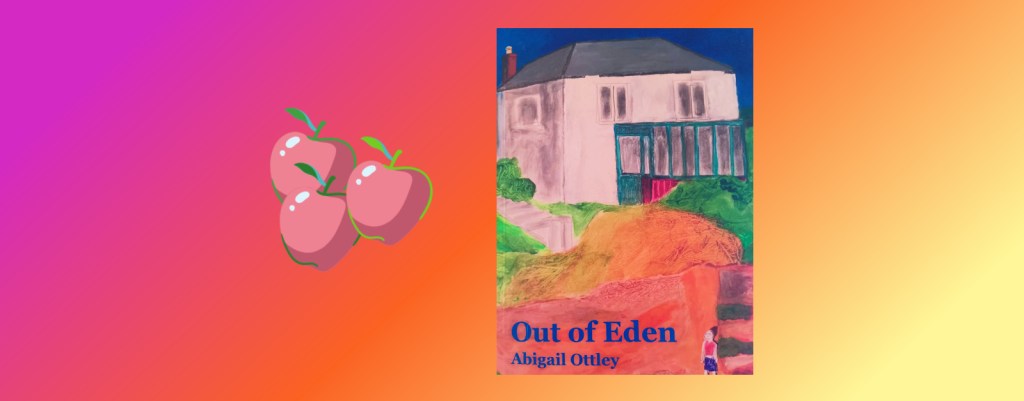
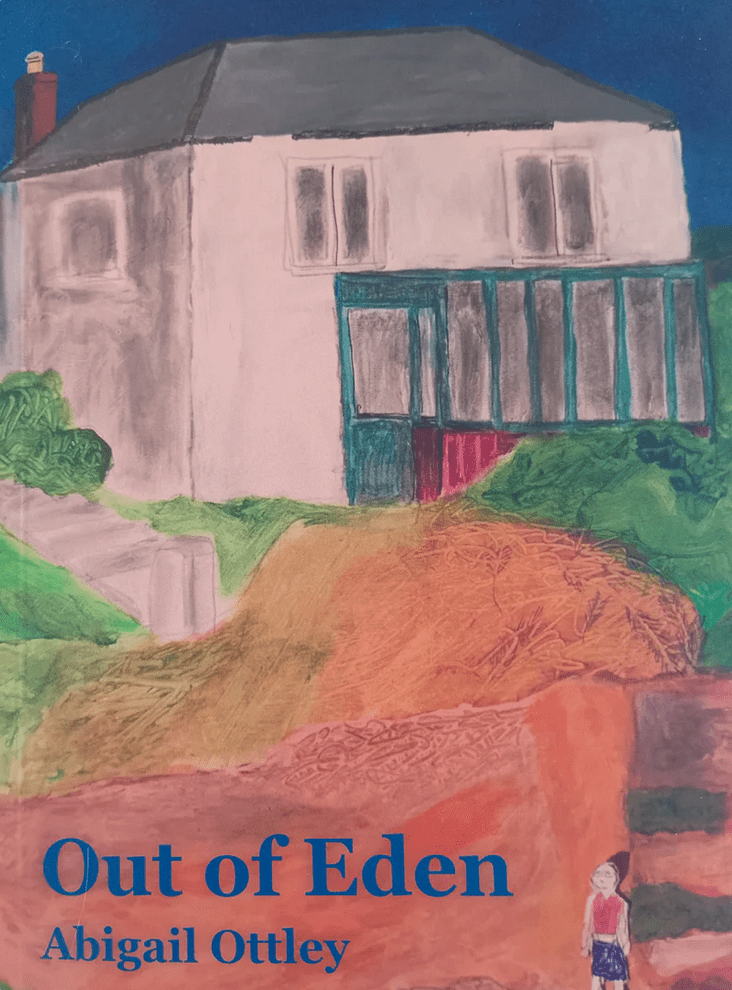
Out of Eden, Abigail Ottley
Yaffle Press, 2025
£12
Why do we read poetry? And, for those of us who are also practitioners, why do we write it? There are many answers to those questions, yet none feel definitive. A few collections of poetry make you long to know the truth though, to reach into the secret knotty heart of a poem and inspect its purpose and provenance. With the best collections, we may also hope to draw something useful from them for our own lives: a model for living, a hard-won lesson, perhaps even a warning.
Out of Eden by Abigail Ottley is one such collection, rich with poems that linger long after the page is turned, demanding answers to questions. Perhaps poetry itself is the key question. A unique, self-contained unit of sound and fury, signifying everything, if only we knew how to break it down, how to parse it. For practitioners, I believe we write poetry to ask the subtler questions that prose can’t get at. And as readers we turn to poetry to make sense of our own lives through someone else’s wordscape. Because a good poem is impossible to transcribe into prose. It always ‘means’ more than the sum of its parts.
So it is with Ottley’s wordscapes in Out of Eden. Here are moments in time that cannot be fully grasped except via the act of reading, which then becomes an act of witness. Because these are poems of women’s bitterness and resignation to injustice, poems that insist ‘daughters are dark’ and in ‘Night house’ ‘spill whole bottles of ink’ in service to the moon. But mothers are problematic too: ‘I try to keep my temper. It’s never easy. She whines and wheedles.’ In ‘Last Supper’ a mother is ‘sharp like a mirror that’s cracked.’
The body and its many betrayals, its remembered traumas, lies at the heart of this collection. And shame lives here too. ‘You could have said no your mum will say. / The policeman will call you something nasty.’ [Persephone’s dilemma] Physicality, the messy and yet often mysterious reality of bodies, takes centre stage, as in ‘Kennack Sands, 1956,’ the memory of a near-drowning as a young child, where ‘the Old Man of the Sea’ ‘grabbed at my leg with his sand-gritty fingers, weed-whipped my belly and chubby, pink thighs’. Or the elderly man in the poem ‘I knew a man’ who, a lifetime after his amputation, ‘would wake in the night crying from the pain in his lost limb.’
Ottley employs prose poems and lyric poems, mostly short and distinctly unsweet, for this outpouring of grief and fury, alongside a determination to set the record straight. Sylvia Plath wrote of poetry as a ‘blood jet’ in her poem ‘Kindness’ and that there was ‘no stopping it.’ Here too the poetry pours out like blood, bearing witness to past traumas, refusing to be silenced, the product of a brave, resilient creativity. ‘I find I have no more fucks to give,’ declares the narrator of ‘Cornwall, mid-1980s’ as she wades out into icy water for a Boxing Day swim ‘until my feet no longer touch bottom’. Bloody-mindedness, fierceness, defiance, these emotions drive Ottley’s poems until they emerge from the fires of her past as tempered steel. And poetry needs to be made of steel in such exhausting times. ‘Your call is important to us. Please continue to hold,’ she writes in her no-holds-barred poem, ‘The cost of care’: ‘This, this is how your life drains away.’
Ottley’s ‘old dears’ also feature heavily in these pages. Her mother and Nana Tilly are the women most drawn upon as models of how to live, how to survive, how to deal with a hostile world. Family past is relived here in a series of thoughtful, precise, delicately tinted vignettes that pulse with emotional intelligence. There’s nostalgia, yes, but not cloying sentiment. These women who shaped the poet’s life and attitudes are portrayed affectionately but also with clear, unflinching vision. So the ageing woman puts on make-up and a show for the solicitor to prove she is of sound mind in ‘My mother the drama queen’: this is her ‘swan-song, the performance of a lifetime’ before the final curtain comes down. ‘Later, you took your teeth out again. We celebrated with tea and cream meringues.’ And yet this is the same elderly woman who ensnares the poet ‘in your parlour where I am your fly,’ ‘palsied by the venom of your bite.’ There seems no love lost here. Except that love is everywhere in these poems, especially for these influential women who moulded her, even if it is a complex, demanding love at times.
Men fare rather worse in this collection, and for good reason. In ‘Manifesto,’ the defiant voice of Elizabeth Button, d. 1896, is recreated: ‘In this world of many men and their bright traps and snares, I will neither creep nor squirm.’ Dreadful, horrific things happen to girls and women in these poems, followed by long, stifling silences imposed by fear and social pressure. Some poems here feel like scars borne defiantly in the face of disapproval and denial. So the stories of outspoken women like Nana Tilly are necessary to provide strength and inspiration, the ability to ‘think on my feet, not be a straw in the wind’ [Nana Tilly and the Tally Man].
The poetic craft on show here is meticulous and gripping, a fascinating, book-length sequence on a theme of the past and family, the people and events that shape and define us. Not only the dead feature here, but memories too, the turbulent products of our past selves, gathered together to be re-examined, scrutinised for truth and – with any luck – for advice we can take forward into the future. ‘Hope is left last in the jar of spites. It sets us up for a fall,’ Ottley writes in her tragicomic poem, ‘After you were born my hair fell out.’ Yet these poems are full of hope as well as love. Hope that this isn’t all there is to life, that we are more than the sum total of our pain and suffering, both known and secret, and the insults and indignities of everyday life. That we can face trouble and even hatred head-on, and be like Nana Tilly who ‘broke every rule’ and was ‘a force of nature’ though she ‘carried no shield except her indignation and wielded no weapon but her tongue’ [Nana Tilly and the Tally Man].
Abigail Ottley has taken such lessons in fierceness and women’s resilience to heart, and these powerful, disturbing, and formidable poems speak of a soul who will not be cowed, whatever the cost. She has faced substantial blows from her attackers – literal blows as well as metaphorical – and come out undiminished. In the magnificently malevolent ‘Like the moonrat I am crepuscular’ Ottley describes that tiniest of creatures, the common shrew, and warns detractors and lovers alike not to be fooled: ‘I can make a skull snap like a twig… I will be no man’s hawk or wet-eyed spaniel. I am Sorex araneus. I bite.’
A lesson there for us all.
Abigail Ottley
Abigail Ottley writes poetry and short fiction. A Pushcart and Best of the Net nominee, her work has featured in more than 250 magazines and journals, most recently in Twisted Ink and Inkfish. She won the Metro Poetry Competition in 2024, and has placed second in the Plaza Prose Poem Competition and twice won the Wildfire 150 Flash Award. Also twice commended in The Page is Printed and commended in the Welshpool and What We Inherit From Water, she recently placed third in the International Patricia Eschen Poetry Prize.
Abigail lives in Penzance where she is a founding member of the all-female Mor Poet Collective.
Facebook: https://www.facebook.com/abigailelizabethottley/
Instagram: https://www.instagram.com/abigail_elizabeth_ottley/
Review by Jane Holland
Jane Holland is the editor of Castle Poetry. In 1996, she won an Eric Gregory Award from the Society of Authors for poets under thirty, was Warwick Poet Laureate in 2007-8, and has published five collections of poetry, including her debut from Bloodaxe Books and a verse translation of The Wanderer from Anglo-Saxon. Her latest collection is Flash Bang: New & Selected Poems from Thimblerig Books. She is also an established commercial novelist; her latest novel is Secrets of Sycamore Hall.
 Castle Poetry
Leave a comment